Showing posts with label unemployment insurance. Show all posts

Sunday, January 8, 2012

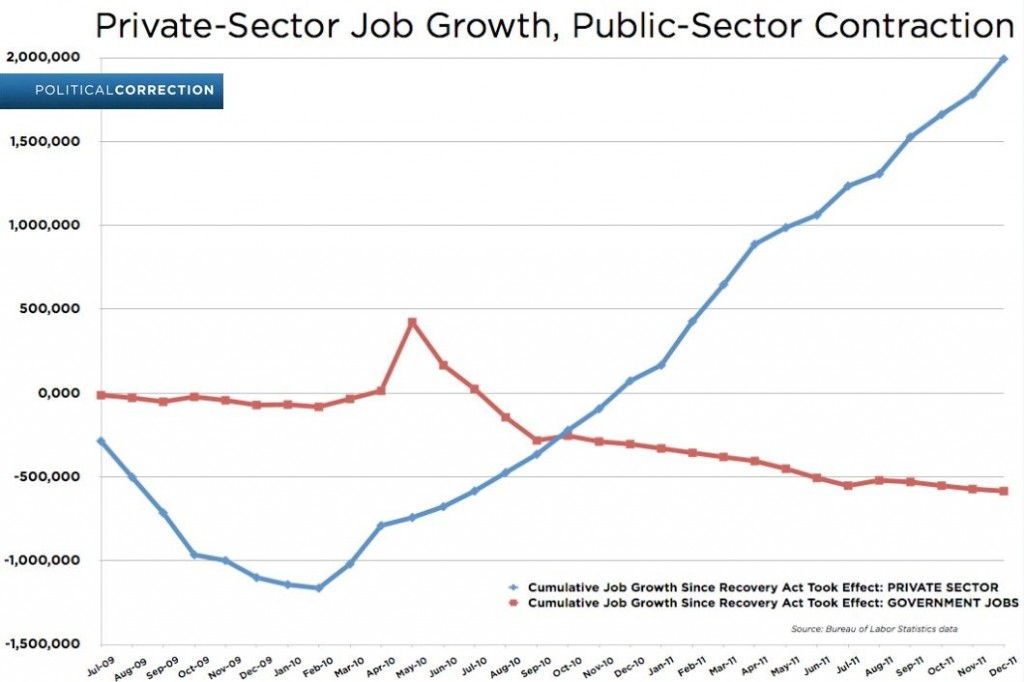
This was so good I just had to clip it (the ThinkProgress url is here but I've noticed content has a strange way of shifting and drifting and disappearing, so I wanted to keep this gem preserved).  Anyone who continues to believe that Democratic presidents are terrible for the economy and Republican ones are wonderful should really look at the actual track record more closely.  I have done my best to puncture this myth, but it persists.  Simply because someone tells you he is a great businessman doesn't mean he is (forgive the gender-specific pronouns, but most Republicans guilty of this self-promotion in the absence of data are men).   Properly, there should be a 6 month lag between changes in fiscal or monetary policy (the things the president indirectly controls) and changes in economic indicators such as unemployment rates, so in reality, President Bush left Obama a legacy of 10% unemployment, not 8.5% which was the headline number the month prior to Obama taking office (and the one that was released on his watch although it reflected data and policies of his predecessor).  This is not to play the "blame game" as the Republicans seem to love to do, blaming the new guy for not being able to drive the car out of the ditch even though they are the ones who had the brilliant idea of taking a shortcut through the swamp in the first place, but to look coldly and squarely at what set of policies actually work.  You can't do that if you use judge President Obama based on Bush's numbers.
So here is this pearl of a summary from ThinkProgress.org:


*

Jobs, Jobs, Jobs

Jan 6, 2012 | By ThinkProgress War Room

Jobs, By the Numbers

2…the number of years of consecutive employment growth in manufacturing, after not one single year of growth between 1997 and 2010.
8.5 percent…the unemployment rate, the lowest since February 2009 just after President Obama took office.
22…the number of consecutive months of private sector job growth.
12,000…the number of public sector jobs lost in December of 2011 alone.
212,000…the number of private sector jobs created in December of 2011 alone.
280,000…the number of public sector jobs lost in 2011.
315,000…the number of health care jobs created in 2011.
673,000…the number of private sector jobs lost during the entirety of the eight-year Bush presidency.
1,080,000…the number of net jobs created during the entirety of the eight-year Bush presidency.
1,600,000…the net number of jobs created during 2011, after accounting for job losses in the public sector.
1,900,000…the number of private sector jobs created during 2011.
IN TWO SENTENCES: In either of the past two years alone, President Obama created more private sector jobs than President Bush did during the entirety of his eight-year presidency. While today’s jobs numbers are a promising sign, it’s no time to get complacent when 14 MILLION Americans are still out of work.

Evening Brief: Important Stories That You May Have Missed

The Florida GOP refused to admit a Muslim man in its ranks, labeling him a “terrorist.”
What science can learn from forecasting science.
Why conservatives can’t do journalism.
States passed a record number of abortion restrictions this year.
How Mitt Romney’s firm drove a steel plant into bankruptcy, but still profited thanks to a federal bailout.
Santorum tells the mother of a cancer survivor that people with pre-existing conditions should pay more for health insurance.
Rick Santorum used to have a centrist record on education, and now he’s running away from it as fast as possible.
Those much-sought-after New Hampshire independents, says one expert, are “really not a bloc of voters.”
Alyssa Rosenberg likes Stephen Colbert’s “uncomfortably aggressive” gags and pranks.
Top 10 U.S. Government Investments in 20th Century American Competitiveness
Today, Commerce Secretary John Bryson held an event at the Center for American Progress to release a comprehensive report, “The Competitiveness and Innovative Capacity of the United States.” In conjunction, CAP’s Jennifer Erickson put together a top 10 list of government investments in 20th century American competitiveness:
  • Ellis Island
  • Panama Canal
  • Hoover Dam
  • GI Bill
  • Marshall Plan
  • Interstate Highway System
  • DARPA
  • Apollo Space Program
  • Elementary and Secondary Education Act
  • Humane Genome Project
THINKPROGRESS | Center for American Progress Action Fund
1333 H Street NW, 10th Floor | Washington, DC 20005

  - source:  ThinkProgress.org, Jan 6, 2012, at 5:05 pm.


Saturday, May 7, 2011

The Ten Biggest Tea Party Fabrications, Part I


The Ten Biggest Tea Party Fabrications
 [Note:  this page is being updated so check back periodically for additions and editions.]

28 days after President Obama took office, the Tea Party was formed allegedly as a populist movement against what its founders, the Koch brothers, described as an out-of-control administration.  I have always been curious what a president 28 days into his new term could do to make so many predominantly white men so mad, mad, mad! (11% when polled did admit that they didn't trust our first African American president because of his race, but the Tea Party claims to have purged its ranks of racists after firing Tea Party Express leader Mark Williams after he made one racist remark too many).  I was hoping to get some insight into this antipathy toward President Obama, something that I must admit shocked me, seeming to come out of right field.   The deafening silence of these white, angry crowds when many of the budget-busting programs were being put into place over the prior 8 years, including the Bush-Paulson $700 billion corporate bailout, seemed curious. 

Well, since then we have had two budget cycles and a midterm election that seemed to validate frustration with incumbents and the status quo.  A number of freshmen Tea Party congressmen defeated seasoned politicians, even Republicans who were seen as too willing to work with President Obama.

The Tea Party narrative goes something like this: 

 Everything was fine until 2009 when an out-of-control tax-and-spend Democrat who was a radical community organizer, a socialist, closet Muslim, and perhaps a Kenyan by birth, became President.   As part of his radical socialist agenda, this president imposed "Obamacare", the "crown jewel of socialism", a "government takeover of healthcare" on an unwilling country.  Doing so would increase government spending even more, which under Obama is already out of control, threatens to bankrupt our country.  Unless we stop Obama and his radical agenda, our best days are behind us as a nation.   Tax cuts and military spending have nothing to do with the deficits or debt, and the last thing a recovering economy needs is a greater tax burden.  As Sarah Palin put it, what America needs is to "get big government off our backs."  Mid-term elections have given us a mandate to abort healthcare reform and massively reduce government spending.  

I think I managed to hit all the Tea Party talking points.   It's hard not to know them, since the Republicans are nothing if not disciplined about being on message.  There is just one problem with them:  almost none are true.  Each either misrepresents recent or historical events or is an outright fabrication.  Let me address the 10 Biggest Tea Party Whoppers:


Claim:  "Government debt has never been higher."
Reality:  In nominal dollars (reported without taking inflation or the size of the economy into account), it is true that our government is facing a record debt, almost $15 trillion.   This number sounds frightening and certainly requires corrective action, but it is not true that it has never been higher relative to the United States economy, which remains the world's largest.   During World War II, debt surged to 117.5% of GDP.    This is not to say that the debt is not too high - by any reasonable measure it is - but the United States during past periods of crisis has mounted and paid off even larger debt levels. 
The United States began as a country in debt and the question was whether that debt should be floated to the public in the form of Treasury bills, notes, and bonds, or simply retired as rapidly as possible.  Alexander Hamilton won that argument, and the world's most successful and secure investment instrument was born.  Even as I write this, with the government borrowing $1 billion a day, lenders around the world (and many American citizens) are willing to lend money to the United States government for only 3.19% for 10 years versus 5.19% when Bush took office and 8.43% when Bush I took office in 1990.  No borrower who is not credit-worthy could ever get such a free ride from bond vigilantes who have far more to do with setting interest rates than the Fed.  If President Obama were such a disaster for fiscal discipline and the United States economy, why are bond investors willing to lend him money 39% lower than his predecessor and almost two-thirds lower than Bush's father.  
Our 30% debt following the Revolutionary War was paid off, but climbed to 30% again during the Civil War, then again during World War I.  It soared to a still-unprecedented 100%+ of GDP during World War II as the United States borrowed massively to defeat Hitler, and is approaching that level following the aftermath of the 2008 economic crisis.  
Unless people believe that the wars in Iraq and Afghanistan will last forever or that the United States economy will never recover, history indicates that crisis-induced debts are always repaid without a catastrophic collapse in the economy or society.   The difference now is that for the first time in the history of our country, perhaps of any country, the United States lowered taxes in a time of war, creating a disastrous, yawning deficit compounded over time into a massive debt.   In a way, this is good news, however, since tax cuts can be rolled back or reversed.  It is likely when all is said 

Claim:  "Obama created the debt."
Reality:   This is the easiest Tea Party fabrication to disprove.   Most of the debt we are facing was accumulated years before President Obama took office, two-thirds of it in the 8 years of his predecessor.  
According to the Congressional Budget Office, the total debt was $5.62 trillion dollars when President Bush took office in 2000.  By the time President Obama took office, this debt swelled to $9.64 trillion dollars, an increase of $4.02 trillion during Bush's two terms.   Approximately two-thirds of our debt was accumulated before President Obama took office.  

Claim:  "Obama's reckless spending increases accelerated the debt build-up, even if they didn't create it in the first place."
Reality:  For those of you with non-financial backgrounds, a few caveats about assigning causality in a field as murky as economics is in order.  (Skip if you took a good Economics 101 course and remember what you were taught.)
What the Tea Party advocates would like us to believe, as would Marxists on the other extreme, is that because there are gaping holes in free market economic theory and disagreement over optimal rates of taxation, government intervention or regulation of the marketplace, or social security funding, we can just make our own economic laws.  Such as "tax cuts always pay for themselves" (they clearly don't), deficits either don't matter (when created by Reagan or Bush) or do (when increased by a Democrat), or cuts to government programs helping the poor will always be offset by even greater increases in private charitable giving.  The biggest pseudo-law, repeated so often its absence of empirical evidence is often forgotten,  is that cuts to top marginal income tax rates will always grow the economy (and have no net effect on the deficit).   There is some weak but contradictory evidence for the first idea, but none at all for the latter.
So with all those caveats, in mind, let's return to the Tea Party's claim that the deficit and debt were caused by a dramatic increase in spending by President Obama.  
For the conclusion to be true, the premise (that Obama dramatically increased spending) must be also.  Did he? 
It depends by what you mean by dramatic and he.
President Bush spent $2.979 trillion dollars his last year in office.  President Obama spent $3.107 trillion dollars his first year in office, an increase of 4.3%.  This is hardly dramatic, but the Tea Party based its largely successful 2010 campaign on this claim.  (Since then, spending has increased further, but at the time the Tea Party made this claim, it was not true.)  (Source:  CBO.)  


  FactCheck.org provided this informative graphic in the middle of an article slamming Obama's Treasury Secretary for falsely claiming his boss's spending would be lower as a % of GDP than under  Bush and comparable to Reagan's.  Note the surge in Bush's term, particularly his final year; the increase under Obama has bee modest and is projected to decline, albeit not to Clinton-level eras.  

Furthermore, what did the Tea Party mean by he, President Obama, triggered this spending?  Brushing aside the observation that Congress, not the president, controls the purse strings, the president can at least communicate his priorities and of course proposes a budget but it's Congress that must create it.  But how much of the budget does the president actually control?  
Of the $3.1 trillion in the 2009 budget he signed into law, the $1.896 trillion, or 60%, was mandatory, meaning they were entitlements that had to be paid based on agreements made (and signed into law) decades before President Obama took office.   
Of the other 40%, much of that was also relatively fixed, including continuation of bailout programs begun by his predecessor (but the bill for which arrived as President Obama took over the White House).   
To be fair to Obama's critics (a favor they never return to the president), the year-over-year increase in discretionary spending he controlled was a bit faster than the year-over-year increase in the mandatory spending he did not, but even taking this into account over half of the increase in federal spending (54%) had nothing to do with who was in control of the White House or Congress.   This money would have been spent even by a President McCain.  Anyone who states that a Republican president would have been able to overhaul Social Security and Medicare after less than a year in office (and have these changes show up in the annual spending numbers for that year) is lying or perhaps unaware that Bush actually tried unsuccessfully to do some of these things for 4 years then abandoned the effort (although he did massively increase Medicare spending by expanding the benefit to include prescription drug coverage, something those trying to make the case that Republicans hate big government always forget).  


Claim:  "Obama's spending reflects a radical socialist agenda that weakens defense."
Reality:  Republicans may be surprised to discover this, but some of the biggest increases in President Obama's 2009 budget (continued in 2010) were in defense and national security spending, even excluding the wars in Iraq and Afghanistan.   $743 billion was spent on defense-related expenditures under President Obama in 2009 versus $700.3 billion under President Bush in 2008.  Say what you will about President Obama, but weakness on defense, at least as measured by expenditures in that area, is not one of them.  
And even here, the idea that President Obama was entirely responsible for these increases (if you are opposed to increases in any government spending, even military expenditures, something most Tea Party advocates claim not to be) is nonsensical, since the largest single military-related agency increase was the Department of Veterans Affairs, whose funding is a function both of demand (the wars Bush started generated a steady flow of traumatized and wounded veterans who now require a lifetime of care) and of response to Bush-era scandals such as those at Walter Reed showing returning veterans getting inadequate care and resources
  It is intellectually and morally dishonest to blame the President who increases care of veterans wounded by wars started by his predecessor.  Whether one agrees with those wars or not (I opposed the Iraq invasion which generated most of the increase in demand for VA services), hopefully even the most radical Tea Party government-hater will agree that we have a moral obligation to pay for those harmed by them.  
So where else did this "radical socialist" President increase government spending?  Compared to his massive military and defense spending, nothing else really comes close, but in order of increase in spending in discretionary programs, he pumped $56.1 billion more into the Department of Transportation, mainly through stimulus spending, and a relatively puny $3.3 billion more into "Department of State and other international programs", an equal increase into the Department of Housing and Urban Development, and $1.1 billion more into the Department of Health and Human Services.   The  Departments of Energy,  Agriculture, and Treasury all received between 2.9% and 3.3% more than under Bush, and NASA's budget was increased by a not-so-whopping 1.7% (which after inflation means its budget was cut in real terms).  
This radical socialist president cut funding on the Department of Labor by $100 million paid less on the interest on the national debt thanks to a drop in interest rates (saving taxpayers a billion dollars), and slashed $10.6 billion (an 18.9% reduction) from the Department of Education.  
When you consider that the Bush deficit massively increased demand for everything from unemployment insurance to Medicaid (by allowing more Americans to become eligible by moving into poverty), it is hard to understand how or why we can honestly blame President Obama for the $36 billion increase in "Unemployment/Welfare/Other mandatory spending" or the $15 billion increase in "Medicaid and the State Children's Health Insurance Program (SCHIP)."  Of course, honesty or pesky things like facts were never barriers to people such as Sarah "death panels" Palin.  

Claim:  "Tax cuts have nothing to do with our deficit or debt and should be ignored in favor of spending cuts only."
Reality:  This is not quite as easy to slap down as most intelligent adults who understand that in the zero sum game of government budgeting, there is no difference between increasing a dollar of revenue (through taxes) or decreasing a dollar of spending (through cuts to existing programs).   Where it gets complicated is that both the economy nor the government budget are dynamic, moving targets, and changes in one affect the other, sometimes in counterintuitive ways. 
To their credit, there is some evidence that marginal reductions in taxes can boost economic activity, but very little to none that these increases in economic activity offset the loss of revenue the tax cuts actually stimulate.   FactCheck.org perhaps put it best in a nice review of this topic in 2008 (since then Bush tax cuts have been extended by President Obama and that debt has surged even more):  

Q:  Have tax cuts always resulted in higher tax revenues and more economic growth as many tax cut proponents claim?
A:  No. In fact, economists say tax cuts do not spark enough growth to pay for themselves.  - FactCheck.org
Now most of us love to make fun of economists (if you want my favorite economist jokes, email me), but what is the alternative to the historical economic record?   However imperfect the intellectual track record of even the worst economists, I will take it over that of a Michelle Bachman, who apparently is confused about the definition of socialism, or Sarah Palin, who could name neither a single paper she reads regularly nor a single Supreme Court decision (besides Roe v. Wade) and seemed under the impression that Africa was a country rather than a continent.  I am not sure why intellectual giants such as this, who took 5 years and as many colleges to get her degree in communications from the University of Idaho, and who apparently believed a Civil War general was running operations in Afghanistan, should be given any more credibility in understanding much less critiquing or (god forbid) forming monetary and fiscal policy than people who at least get the basic facts right.  (We are free to disagree with their premises, but not to make up our own historical record.)
It is true that despite the tax cuts, revenue increased somewhat under President Bush from $1.991 trillion the year he took office to $2.524 billion the year he left.   But this 26% increase in revenue was far less than the 42% increase in GDP that occurred over that time frame, meaning that had the rate of taxation of this expanding economy remained constant, we would have no deficit.  Revenue as a percentage of GDP fell from 20.9% the last year of Clinton's administration to 17.6% the final year of Bush's office.   Some very simple math would indicate that had this plunge not occurred, there would be virtually no budget deficit.
Using a 2010 GDP of $14.6 trillion, had the government collected a Clinton-level 20.9%, the total inflows to the government would have been $3.054 trillion instead of the $2.162 trillion actually collected.   This additional $889 billion would not have eliminated almost two-thirds of the deficit.  When you consider that $260 billion spent on interest on the debt would have been eliminated had the Clinton surpluses not been turned into deficits because of the Bush tax cuts, the total savings would have been $1.149 trillion, wiping out all but 17% of 2010 actual deficit of $1.390 trillion!  
Now, Tea Party activists who have never heard of fungibility and Starve the Beast activists who have argued that creating a fiscal crisis is the only way to mobilize political support for the radical societal changes they envision argue that this assumes that the economy would have grown had the Bush tax cuts not been passed.  In other words, it does you no good to take 20.9% of a pie if that pie shrinks or grows slower for want of those tax cuts.  Fair enough, and most economists agree tax cuts can stimulate some growth at the margin, but there are several ways of pointing out the flaws of this counter-argument:
    First, most economist do not agree that the increase in economic growth offsets the decrease in revenue from lowering tax rates. 
    Second, there is no empirical evidence that government spending is inversely correlated with economic growth; if anything, there is a very weak positive correlation between government spending and change in GDP over the next year from 1977 to 2010.   
    Third, the correlation between individual income taxes collected and subsequent economic growth is not only weak, but positive, meaning higher individual income tax collection rates are associated with stronger economic growth, as measured by year-over-year change in GDP.   The same is true for aggregate tax collections - higher collection rates are associated with slightly higher rates in economic growth.  Now it maybe that if income taxes are lowered dramatically below the record 5.7% low set by President Obama in 2010, something magical will happen that has not happened in the range of values experienced from 1977 to 2010, but when someone claims lowering taxes stimulates the economy and raising them slows economic growth, the burden of proof is on them to explain why this has not been the case over the past 35 years or so. 


Claim:  "President Obama is foreign-born (and therefore by implication not eligible to be president)."
Reality:  This claim has been so thoroughly and repeatedly debunked it is not worth addressing seriously.  Even before President Obama humiliated television personality and failed businessman Donal Trump by releasing his long-form birth certificate (something no white president was ever asked to do), this was an urban legend irresponsibly advanced by the Tea Party as a pseudo-controversy.  Factcheck.org decisively shot it down long ago.  It deserves no further comment. 

 To be continued....

Monday, May 2, 2011

Osama bin Laden was killed by socialized federal government employees


So Osama bin Laden is dead.   The brave sacrifices of those socialized government workers (Navy seals) and the socialized medical team waiting to save their lives if needed and the socialized flight team who flew them in and out in government vehicles tell us there must be something other than greed that makes people do great things. 
Only last week, many on the right, especially in the Tea Party, were claiming that without greed as a motivator, the titans of industry - CEOs and hedge fund managers - will not be motivated to do great things, producing lots of jobs in the process.  Unless of course you're a teacher, fireman, or cop, earning $50,000 a year, in which case a reverse sort of motivation occurs in which under-performing teachers will improve their performance if their pay and benefits are slashed.
This successful military strike was just the most recent reminder that public servants with no hope of personal enrichment can really amaze us all.   
That was my first thought actually when I saw the rows of white crosses and occasional stars of David at the American cemetery at Normandy - all these guys who laid down their lives for us but all of them public workers, none of them well-paid, but financed by taxpayers who did not flinch at paying 90% top marginal tax rates to support the war of their time.  Greed and materialism simply could not explain this massive human endeavor, this tremendous sacrifice, and it can't explain the far lesser sacrifices we are asked to make today.  I guess that's why we call them the Greatest Generation and although there are few of them out there, that spirit of shared sacrifice and a common community is dying outside of the military. 
I support brilliant businessmen and women, but from what I have seen of those in charge of Enron, Worldcom, Healthsouth, Citigroup, Lehman, and AGI, I am not so sure they are as brilliant as their obscene pay packages should indicate.   
What exactly did Pfizer CEO Henry McKinnell do in a recent year (2002) to take home $33,912,294 in compensation?  According to Barrons (no left wing publication), Pfizer could have replaced Mr. McKinnell with 400 researchers to come up with new products. 
I'm not sure what value UnitedHealth Group CEO Stephen J. Hemsley added to justify his $98.6 million in exercised stock options in February, 2009.  His company doesn't make or do anything; it just collects premiums, lots of them, then he helps himself to $100 million of them, and pays out what is left out for pap smears and mammograms.   He didn't help the soldiers in this operation.   I'm sure he works hard, but so did the Navy seals and they are not taking home $100 million of other people's money. 
And are CEOs that much smarter than they were when we were kids?  The average CEO made 531 times what the average worker made in 2001 versus 26 times in 1965.  
I'll bet a number of the people risking their lives in this operation have family members on public assistance, public assistance being gutted in many cases to finance tax cuts for CEOs and hedge fund managers.  Many will need help re-adjusting upon their return and that will cost money, lots of it.  
Every returning veteran from World War II got 18 months of unemployment insurance benefits, no questions asked.  It just seemed the right thing to do. 
These things are all linked and it seems those who hate the government and its workers so much in one week that they think it must be slashed to finance tax cuts for a wealthy elite (most of whom have not served in the military and do not have children who will serve), should not turn around the next week when that government has done something brilliant and claim to have supported them all along.   
I am frankly tired of fantastically well-compensated infotainers who make a living jabbing at teachers, firemen, cops, and public servants of all stripes.  I think it's time we jab back a little and ask them to pay their fair share.

Monday, March 28, 2011

Beck Like Marx Should Stop Theorizing About Capital and Go Out and Earn Some (Honestly)

This review is from: Broke: The Plan to Restore Our Trust, Truth and Treasure (Hardcover)
I must admit that this looks like a carefully-thought-out book. It has side bars and historical quotations and is even peppered with some facts. It stretches over a few hundred pages. And the writing style is at times amusing, at times amusingly pompous, but rarely boring. However, appearances are deceptive as any Fox News viewer should have discovered long ago, and anyone who expects to be enlightened by this book by a former chemically dependent Top 40 DJ turned part über-patriot, part televangelist Fox employee, will be as disappointed as one should expect considering the source. Beck illustrates the dangers of trying to get historical, political, or economic advice from professional entertainers. 

Let's start as Beck does, with religion. On page 6, Beck cites the fact that 12% of Americans state they have "no religion" in 2008 versus 2% in 1948. Since he gives this sidebar along with other indicators establishing the decline of what he calls American "empire," and inserts it in a parallel discussion of the decline of the Roman empire, we can only conclude that he believes that a decline in religious affiliation (and he elsewhere says of the Judeo-Christian variety) is associated with a decline in empire. Perhaps he does not realize this, but early Christian writers such as Augustine were tortured by it: the Roman Empire which lasted centuries collapsed shortly after adopting Christianity as the official state religion. This may have been true, true, and unrelated, but it does not support his case that religiosity is important to empire maintenance. There was a correlation between Christianity and empire in the case of the Romans - an inverse one. 

It is unclear why Beck holds up the Roman Empire as a model to emulate anyway, since only a minority of wealthy men could engage in politics, slavery was a cherished institution, and torture, aggressive war, and mass crucifixions were considered appropriate powers to be granted to a central government. This hardly seems the stuff of the "Don't Tread on Me" Tea Party. 

The "simple" recipe that Beck gives for the decline of this Empire, however little it is analogous to the world we live in, is that "the state encroaches on freedom... people want more handouts ... taxes go up to pay for the handouts." Now I will admit to not being a Roman historian by trade, but I have read and studied the works of those who are, and have never heard this theory. Beck is the first person I know of who has ever described ancient Rome as a welfare state. Rome's fall was complex, but it wasn't that it cared for its poor or paid its teachers too much (it didn't have any publicly paid teachers anyway). 

"God's hand has been evident throughout American history" he tells us on page 13, and he attributes to this deity the additional gift of books, technology, and history. This is an interesting theory since European Christians spent so much energy destroying the works of pre-Christian Greece that many were lost forever and those that we have were largely preserved in the Muslim world. The Romans were far more steeped in the intricacies of Greek history and civilization than Mr. Beck - many sent their children to be educated in Athens - but that did not prevent their empire from collapsing. 

At any rate, and this seems a far bigger flaw, Beck repeatedly confuses freedom and empire. Many would argue they are diametrically opposed. Yes, being a subject of a great empire such as Rome gives you a certain freedom - from raids by enemies of that empire, for example - but you must exchange certain freedoms and pay tribute (taxes, Mr. Beck, lots of them) to Rome and provide men for the Roman Army. You must pledge loyalty to the Roman emperor and in the final days of the Roman empire you had to renounce your religion in favor of the state religion (Christianity). Whether these losses of freedom (to worship according to your conscience, to be loyal to your local leaders, government, and tribe, and to retain money and men that would have to be handed over to the state) were offset by the freedoms membership in that empire gave you is debatable, but the fact that the Roman Empire generally expanded through the sword, not persuasion or buy-in of the conquered, argues otherwise. Even after many areas were conquered, such as Judea or present-day Germany, the Romans were subject to frequent violent uprisings; Jews and Germanic tribes and Gauls and many others apparently did not share Beck's rosy view of the Roman legions as liberators. 

Beck passes off another myth of the religious right, that the "United States was founded on Judeo-Christian principles." Adams and Jefferson are both on record, as is Congress in a resolution to that effect, that the United States is in "no sense a Christian nation." God is mentioned not at all in the Constitution and only twice in the Declaration of Independence (in passing as the god of nature, not Jesus or Yahweh). "In God we trust" did not appear on our coins until the Civil War and the words "under God" were not inserted into our Pledge of Allegiance until the height of the McCarthyist hysteria in 1954. Most of the founders were Deists. At least one (Jefferson) was an atheist. 

Beck bemoans the fact that 12% of Americans cite no religion in 2008 but only 18% of Americans belonged to a church in 1776. True, the 82% who did not attend church may have told a pollster back then that they still considered themselves to have some sort of religious affiliation, but the generation of the Minute Men and the (real) Tea Party was far less religious than Beck's generation (slightly fewer than 60% of Americans belong to a church today). 

The idea of the "Judeo" part of that Judeo-Christian formulation would have been particularly curious to our founders. After all, we were a country that had strict quotas limiting the number of Jewish immigrants even during the Holocaust or that limited Jews from joining certain clubs or even attending certain universities (the SAT was developed in part to counter claims of Jewish preference by those who felt too many Jewish students were getting into the nation's top colleges). 

Beck's frequent quotations of Benjamin Franklin and even Aesop's fables on the importance of frugality and hard work are curious coming from a man who spent most of his life as a Top 40s DJ and by his own admission was often chemically altered and spiritually lost. If Beck, who now works as a highly paid entertainer, had a real job at some point in his life, it's not evident on his CV. Yet he feels he is in a position to lecture to the millions of hard-working Americans who do that they should stop whining about their working conditions or compensation and help him keep the hundreds of thousands he saves each years in taxes on his multi-million income stream as a Fox News and radio entertainer. 

There is something almost offensive about a man such as Beck misrepresenting Benjamin Franklin who fought so hard to keep religiosity out of the public square. Franklin successfully argued for substituting the phrase "self-evident" (reflecting his enlightenment preference for observation and reason) instead of "sacred and undeniable" (Thomas Jefferson's original wording) in the Declaration of Independence. He said light houses are more useful than churches. Franklin also had some progressive ideas that Beck would ridicule (if he knew about them, which apparently he does not). For example, Franklin never patented his inventions, believed scientific inventions should all benefit mankind. Greed did not motivate him. He had made his fortune by hard work at age 42, but said he wanted to spend the rest of his life finding a way to "do well by doing good." He invented the Franklin stove in 1741 because other designs led to frequent house fires and burn accidents, as well as smoke inhalation. He created in 1751 the first hospital in America, Pennsylvania Hospital. It still stands today. It was raised using matching private-public grants. He found the Philadelphia Academy which became University of Pennsylvania to promote public curiosity and service through the liberal arts in its students. Yes, LIBERAL arts, Mr. Beck. 

It's also interesting that nowhere does Beck mention one of my favorite Benjamin Franklin quotations, in which Franklin chastises people like Beck who whine about their high taxes. "Friends and neighbors complain that taxes are indeed very heavy, and if those laid on by the government were the only ones we had to pay, we might the more easily discharge them; but we have many others, and much more grievous to some of us. We are taxed twice as much by our idleness, three times as much by our pride, and four times as much by our folly." In other words: get over it. We tax ourselves far more than our government does (but which do you think it easier to complain about?). 

And let's not forget - before getting too misty-eyed about the days of Ben Franklin and his fear of a government that might tax one tenth of his income that in his America, fully 1 out of 5 Americans had a 100% tax rate. Slaves - who of course were not paid at all - in effect had all of their wages taxed away even though it flowed not to the government but to their owners. That works out to an average American tax rate of 20% before any other taxes are even considered, far higher than the current 15% (of GDP) tax "burden." The much higher tariffs of the time not just internationally but between states represented an embedded tax in every product. Beck ignores slavery in this book and in his calculations about the burden of government, but it is hard to see why we should be trying to hard to turn back the clock to a time when our government collaborated with slave-owners to insure they could expropriate 100% of their income and even beat them to death or sell them like animals if they chose. Of all the evil powers Beck believes our out-of-control federal government, it does not - thank God! - have that one. 

Beck claims, without any supporting data (a theme of his approach to just about everything he writes), that "frugality ignites freedom." Is this really true? Do nations with higher savings rates have higher freedom? By that measure Japan should have far greater freedom than the United States. So too should socialist Germany and communist China (which he condemns elsewhere despite its eagerness to buy our debt). If it is government frugality he extols, is it true that governments that spend less as a percentage of GDP are found in countries enjoying greater freedom? Was the United States freer at its founding when the central government was so small and spent so little that it essentially did not work, requiring the Articles of Confederation to be scrapped for our current system? I imagine if Beck had surveyed the one out of five Americans who were slaves in Colonial America, his answer not only would have been no, but hell no. If he had asked the 50% of citizens who were female and therefore unable to vote, own property directly, or have their testimony fully counted in court, they would have also not given a glowing endorsement of Beck's freedom through frugality thesis. 

On page 33, he takes one of the first of his gratuitous swipes at "progressives" who did not appreciate the fruits of the "Tree of Liberty." No, in those days which Beck wants us to believe were so golden because the government spent less and had less debt, progressives felt that our country should be judged by more than one variable, and that freedom should not be the gift of a few white men (only 7% of the country could vote in Beck's Golden Age of Low Government Spending) but the right of all people, including women and people of color. One of those crazy progressives who had such subversive ideas? None other than Ben Franklin whom Beck spent so many earlier pages praising. Not only did Franklin promote progressive societies for improving public education and public health using public funds but he also was one of the first proponents of this radical notion that would become known as emancipation. What a liberal! 

Beck goes on to praise Lincoln while somehow sidestepping the fact that Lincoln introduced the first federal income tax (to pay for the Civil War). 

He gives a cartoon-like summary of the Cold War on page 320, stating that we wisely outspent the Soviets, driving them into bankruptcy by patiently waiting for oil prices to decline "drying up one of their main sources of income." Hmmm. A cursory examination of oil prices will show that the glasnost and the revolt against Soviet communism was relatively uncorrelated with oil prices, and Russian dependence on oil revenues increased exponentially after the collapse of communism, not before, as improvements in technology and better East-West partnerships led to more efficient exploitation of this natural resource. Again, Beck offers an idiosyncratic view of history that is generally not taught because it is generally not true. 

One of the most maddening things about Beck's approach is that he claims as his ideological soul-mates people who espoused progressive ideas radically different than Beck's. Besides Franklin and Lincoln (and Jesus), Beck also feels compelled to quote President Dwight Eisenhower on page 321, who made the point that security is the product of economic and military strength. Fair enough, but Eisenhower also railed against the "military-industrial complex" (a term he coined) that Beck adores, and reminded us that ever dollar spent on bombs is a dollar that cannot be spent on schools or roads or the poor. He slammed those who now form the ideological core of Beck's Tea Party, calling them "a splinter group" that wants to "abolish social security, unemployment insurance and eliminate labor laws and farm programs," and that "among them are a few Texas oil millionaires" but "their number is negligible and they are stupid." (- Dwight David Eisenhower, 11/8/1954). Today such a remark would probably merit a special place of honor for President Eisenhower on Beck's chalkboard of shame, perhaps with an arrow pointing straight back at Mao. 

"Warriors aren't whiners," Beck intones. "Our soldiers, sailors, airmen, and marines are the best damn [sic] people on the planet. Period." Yet despite this high praise, Beck did not feel it necessary when younger to serve in the military. He did cheer them on from the sidelines, however, spinning tunes for them as a disc jockey and this is something perhaps, but his absence of service undercuts the credibility of his praise. In his defense, though, he does advocate slashing military spending by 30-40% but his means of doing (reducing overhead) is beyond idealistic. I would argue, as would Eisenhower, that we need to move away from a permanent wartime level of spending in which every politician and many American workers and contractors have a deep dependence on military contracts. It is unclear what advantage we gain from having 6,000 nuclear warheads (6,000!) in an age when 19 guys with box cutters make those weapons beyond obsolete. 

I agree with Beck that our tax code is complicated, but there is a difference between complexity and fairness. He deliberately conflates the two. He states that a progressive tax code punishes the wealthy but offers no example to support this. The wealthiest countries in the world all have progressive tax codes. The poorest and most corrupt don't. A progressive tax code is not an advanced, wealthy society's obstacle, but its natural byproduct. Taxes are the dues for living in a civil society. 

He makes ludicrous claims about a monolithic movement of which I am unaware he calls "progressives" who, he tells us on page 351, want "to take this country from self-sufficiency to serfdom; from pursuit of happiness for all, to guaranteed happiness for none." I have never heard anyone advocating such a plan. I have heard them advocating a return of marginal tax rates to Clinton era levels (or the even higher Reagan era levels in some cases), or doing something about the 59 million Americans without health insurance, or enacting sensible firearm legislation to prevent someone so mentally unstable he was evicted from a college and rejected from the Army from purchasing a 9 mm semiautomatic weapon with an extended round magazine. That sort of thing. The "guaranteed happiness for none" part is alien to me. 

Beck has lots of quotations and some cute sidebars, but what he lacks is any sense of context. As is true with many self-educated and self-declared pundits who seem to confuse a large (but shrinking) television audience with credibility, Beck's gaping holes in scholarship make his premises so full of holes that his conclusions cannot be taken seriously. Only a man who does not understand (or perhaps does not care) about the horrors slaves had to endure in Colonial America or those conquered and crucified by the Roman empire (including one long-haired, bearded pacifist who preached a far more radical form of wealth redistribution than any contemporary progressive) would hold these periods up up as worthy of emulation. Only someone who is clueless about Benjamin Franklin's progressive secularism would devote so much of the early part of the book to him. And only someone who does not understand that tax cuts and out of control spending on a military equipped to fight an enemy that no longer exists have led us into our fiscal crisis, not the relative pittance we spend to help the least among us, can write this book and expect anyone to take it seriously. 

Beck is on record as calling our first African American president a "racist" with a "deep-seated hatred of white people." He condemned those who rose up for democratic reform in Egypt and Tunisia and Libya as a "virus" that would infect the entire region. Never has a man who had been so wrong so loudly and so repeatedly been paid so much to do so little. We could say the same thing about Beck and other right wing blowhards that the mother of another wildly speculating but generally unproductive and incorrect pseudo-intellectual, Karl Marx, once said: I wish he would stop theorizing about capital and go out and earn some. Honestly. 
Why no voting buttons? We don't let customers vote on their own reviews, so the voting buttons appear only when you look at reviews submitted by others.

Search This Blog