March 27, 2017
In 2013, while crossing the street to catch her school bus, my daughter was hit by a car. She fully recovered, but her minute of unresponsiveness and the subsequent hospitalization was a terrifying experience that I hope no parent must go through.
So I've accumulated here a few tips for pedestrians and drivers that might reduce the risk of a tragedy from low to astronomically low. I presented the following to my daughter's school administrators in the hope that it might be helpful to the parent community, and am posting it here as well.
Background
According to the CDC, 4,735 pedestrians were killed and 150,000 injured in traffic crashes in the United States in a recent year, about one pedestrian death every 2 hours. Atlanta ranked as the 8th most dangerous city in the United States for pedestrians according to Dangerous by Design's 2014 survey, which also noted:
- 16 times as many pedestrians are killed on American roadways as die in natural disasters.
- Pedestrian deaths now account for almost 15% of all traffic deaths.
- Georgia is the 5th most dangerous state to be a pedestrian with a pedestrian danger index (a combination of pedestrian deaths and pedestrian density) double the national average.
- Pedestrian accidents are a leading cause of death of children 15 and younger. Between 31-61% of all injury-related pediatric hospital admissions are from pediatric accidents.
- Children are especially vulnerable because they are less visible to motorists, less able to judge the speed of oncoming traffic, and often do not see cars coming. Since they do not drive themselves, they may not appreciate how difficult they are to see, especially if they dart out into traffic from between parked cars.
- 112 Georgians were among the 4,394 children aged 1 to 15 killed as pedestrians in a recent 8-year stretch.
Some tips for pedestrians
Don’t jaywalk and train your children never to jaywalk. Many parents stop their cars in the middle of a block only a few feet from a stop sign but instead of walking their children safely along the edge of the road to the stop sign to cross there, they allow them to cross in the middle of the street. This is extremely dangerous and blocks the flow of traffic. Since all drivers must stop at a stop sign, this is the safest and most convenient place for all to cross. Even if an accident does occur, the vehicle will be going very slowly.
As parents, we must practice what we preach. It is both good citizenship and good for our hearts to always use designated pedestrian crossings. Jaywalking seems a trivial crime but the cumulative probability over a lifetime of crossing where drivers do not expect to see pedestrians is high.
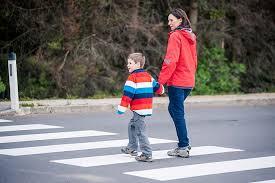
Cross the street directly, not diagonally. Cross streets directly in a straight-line perpendicular to the flow of traffic. Crossing diagonally increases exposure to traffic and the probability of being hit. We should train our children to make eye contact with any drivers, not cross until the car has come to a complete stop, and to continue to swivel their heads as they cross. We should train our children to always assume that drivers have not seen them, never to dart out into the street, and to do whatever it takes to make themselves visible or audible.
Pull the earplugs. Many students seem oblivious to drivers at least in part because they are listening to music, so are distracted and unable to hear cars they may not have seen. At least while crossing streets, it would be best to mute the music or pull the earplugs out. Since there are many more hybrid and electric cars on the road that make very little noise - so won't necessarily be heard - it is critical to remember that the car that hits you is the car you don't see or hear.
Face traffic. Students walking to school along streets with no sidewalk should never have their backs to traffic. In most cases, this means walking as close to the curb as possible on the left side of the road facing oncoming traffic. I cannot count the number of times I have seen students walking to school on the right side of the street, sometimes drifting into traffic without realizing it.
Wherever possible use sidewalks. I've seen parents as well as children walk in a street already narrowed by parked cars on either side when a perfectly good sidewalk is available. If an obstacle is blocking the sidewalk, such as a trashcan or debris, feel free to move it - sidewalks are considered public property that you have a right to access freely.
Tips for drivers:
Slow down! The single biggest thing we could all do to decrease the probability of serious injury or death to a student is to decrease our speed. If you are going 30 mph and hit a child, you are nine times as likely to kill her as is a driver going 10 mph. Our kinetic energy (and hence our risk of killing someone) rises as a square of our velocity, so halving your speed increases a child's chance of living by at least 75% (more, since you are less likely to hit a pedestrian in the first place if your drive slower). Also, come to a complete stop - not a "rolling stop" - at stop signs and always use your turn signal.
Get off the phone. Although calling while driving is legal in Atlanta, that doesn't mean it's wise. A driver who is using a cell phone - even with a hands-free device - is as impaired as someone driving intoxicated. At the very least, why not get off the phone when you are near the school? That call can wait. If you cannot resist the impulse to answer that incoming call, then silence your phone and put it in the trunk or somewhere out of reach when you drive.
Distracted driving is particularly lethal for younger drivers; 21% of teens involved in fatal accidents were distracted by their cell phones. Teen drivers are those with the highest proportion of distracted-driver accidents.
And it should go without saying, but NEVER text and drive. A driver going 55 mph who looks down to check a text message covers an entire football field before looking up.

This also applies to pedestrians. A distracted cell phone user is oblivious to traffic and greatly increases her risk of being hit by a car.
Consider carpooling in a smaller car. Larger cars are not necessarily safer than smaller ones (SUV's and trucks are particularly prone to rollovers that caused almost half of all motor fatalities) and block everyone else's visibility. Larger cars also give their drivers the illusion they are driving slower than they really are. They clear potential bottlenecks far less easily than smaller cars and are ecologically harmful. Your car's mass might be the critical factor determining whether a struck pedestrian lives or dies.

Remove grill bars (aka bull bars) from your car. I have lived in Atlanta for over 20 years and have yet to encounter any cattle crossing the road. Grill bars are extremely dangerous if you hit a pedestrian, concentrating all the force of your vehicle in a much smaller area, pushing the child forward then under the vehicle instead of against the curving front of the vehicle. German researchers determined that although 95% of children would survive being hit by a car at 20 miles per hour, a car equipped with bull bars could inflict the same damage at only 12 mph and would kill a child at a speed as low as 10 miles per hour. This is another reason not to carpool in a truck, SUV, or Land Rover type vehicle since these are the vehicles most likely to be equipped with pedestrian-killing grills.
Please don't idle. I have noticed that despite clearly-posted "no idling" signs, many drivers waiting to pick up children ignore them. Please turn off your car's engine if you are going to be stopped for more than 10 seconds. Some idlers do so because they believe (incorrectly) that restarting an engine uses more gas than idling. Restarting the engine of a modern car uses the same gas as about 10 seconds of idling, so for anything longer than this, please stop emitting the harmful pollutants that hurt the lungs of our children as well as contribute to smog in the short term and global warming in the longer run (an idling car emits about 1 pound of CO2 every 10 minutes). Auxiliary power can be used to recharge a phone or play audio without burning fossil fuels near our children.
I know that's a lot to digest, but I've thought about these issues quite a bit over the years. I would much rather ruffle someone's feathers if doing so might help make the morning carpool experience even a little bit safer.
- Mike Victor
